Conventional septic systems have been widely used in the US since the 1940s. In Florida, nearly 1 in 3 households depends on a septic system. UF/IFAS researchers estimate more than 2.5 million systems are in use across the state. Duval County alone is home to tens of thousands of septic systems.
The basic components of a septic system include the underground tank and a drain/leach field.
They are designed from a public health perspective, and as long as they are properly sited and

maintained (placed in adequate soils with proper setbacks from the water table), they typically do an excellent job of removing pathogens and protecting human health. In Florida, this setback from the water table means that the septic drain field may be level with the surrounding landscape or raised up as a mound above it.
One thing to note is that even though they do an excellent job removing pathogens, they do not always do an excellent job of removing nutrients. A conventional septic tank removes only about 30 percent of the nitrogen that flows into it. That means even a well-maintained system will become a source of excess nitrogen to the surrounding soil and can leach to groundwater.
Furthermore, failing septic systems can easily contaminate groundwater, private and public supply wells, and regional water bodies. Proper maintenance is critical to prevent systems from failing. Part of that revolves around landscaping. We get questions at the office about what plants can be placed on and around a drain field. After all, roots in the ground are a requirement to reduce erosion and help soak up extra water and nutrients in the area.
Simple turfgrass is the most common landscaping over drain fields
On Florida-Friendly yard reviews we see most septic fields covered with turfgrass that is dotted with native moisture loving “weeds” such as dollarweed, violets and dichondra.
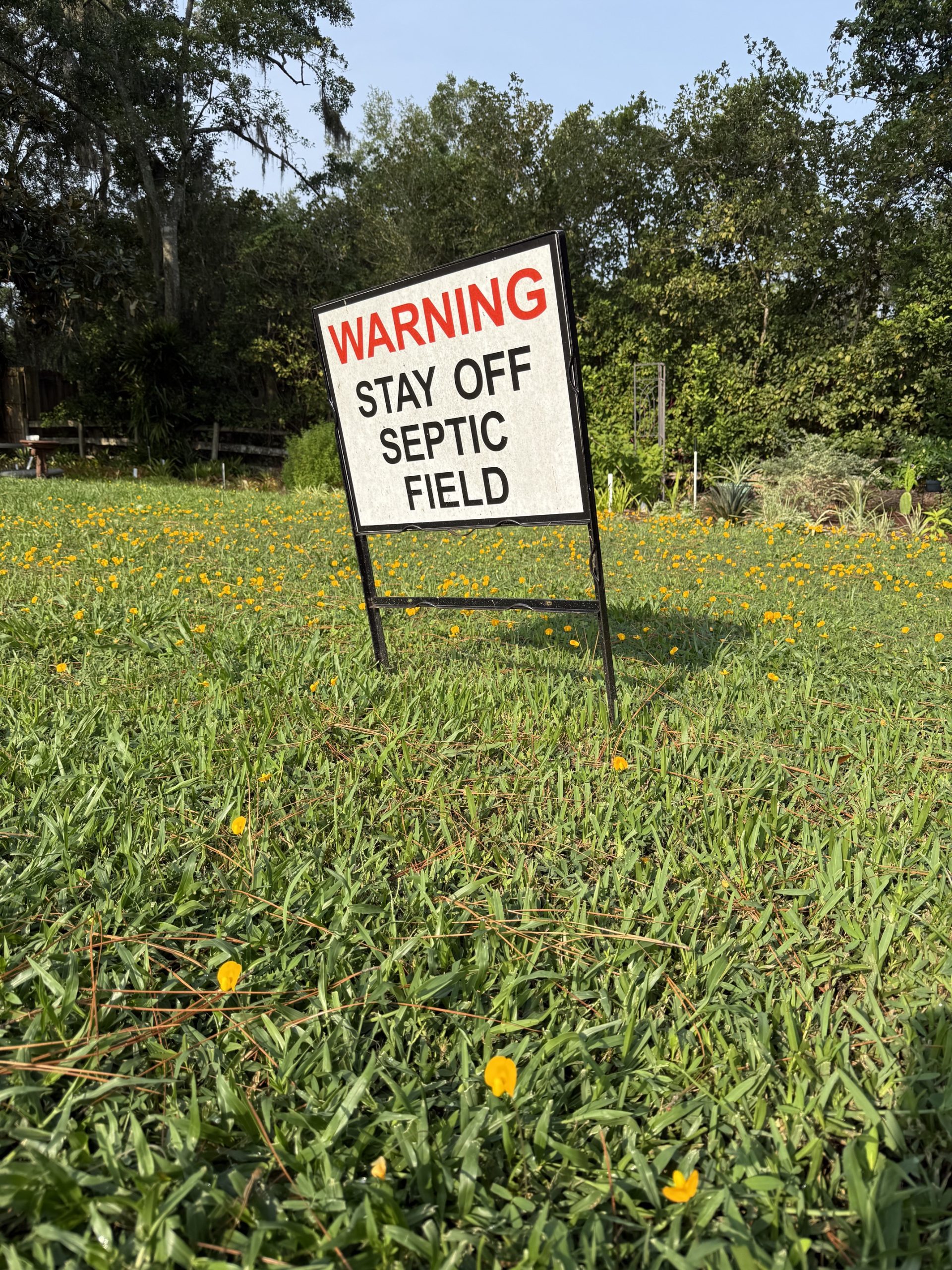
If you cannot or do not want to plant turf, other plants can be used, but there are some factors to consider when selecting plants for your site
- Avoid plants with deep taproots such as sunshine mimosa, bamboo, pampas grass etc.
- Do not choose plants that require supplemental fertilizer or irrigation
- Do not plant vegetables or fruits
- Avoid planting woody plants, shrubs and trees around the drain field. Tree roots can grow 2-3x the diameter of the mature width of the canopy
- The drain field needs sun to perform optimally, so do not shade the area heavily with trees and shrubs- even planted at a distance
- The use of shallow rooted water-loving herbaceous plants such as aster, blue stem grass, plumbago, pink muhly grass, yarrow, coreopsis, river oats, iris, columbine, phlox, liatris, gaillardia, black eyed susans, spiderwort, cardinal flower, cast iron plant, perennial peanut, milkweed or frogfruit are good native and Florida-Friendly alternatives.
- Skip planting things that will need repeated division over time to reduce the risk of damaging the septic field

Drain field pipes can be just a few inches beneath the soil and 18-36” wide, with pipes 8 to 10 feet apart. Here are some more things to avoid when landscaping on or near a septic drain field:
- Adding more soil to the area
- Tilling the area for planting
- Mulching any of the drain field area (plastic, bark, rock, or any type of mulch)
- Using landscape fabric
- Digging with shovels or tools below 6” in depth
- Irrigating within 10’
- Driving vehicles or heavy machinery over the area
Neighboring trees too close to the system?
Barriers of various types have been designed to deflect roots. They are typically installed vertically in the soil to a depth of at least 2’ with the intent of directing roots to grow deeper into the soil, or to grow in another direction. They need to run the entire length of the drain field. To install a root barrier some of the tree roots may need to be cut. Just as a landowner can trim limbs that overhang their property line, they can also trim roots of a neighboring tree. Be sensitive to the tree and make minimal, clean cuts to ensure the least amount of harm is done.
Caring for a property with a septic system comes with great responsibility and some limitations. There are a lot of factors to consider, but with some careful planning this area of your landscape could become a beautiful feature full of flowers and aesthetic appeal.
Resources:
https://programs.ifas.ufl.edu/septic-systems/
https://hgic.clemson.edu/factsheet/landscaping-over-septic-drain-fields/
https://hos.ifas.ufl.edu/woody/root-growth-barriers.shtml
https://ask.ifas.ufl.edu/publication/SS687
This article was written in September 2026 by Duval County Master Gardener Volunteer, Stephanie Means.
 2