Sometimes immediate action is required due to an imminent threat. But when it comes to improperly identifying a problem in the landscape, positive identification is essential. Take for example the questions we receive about lichens and/or Spanish moss, or ball moss on trees – is it a problem, are they killing my tree? The short answer is “no”. These “clingers” are not parasitic and really do no damage to branches or bark. They sometimes look unsightly and manage to scare homeowners into thinking that they are slowly taking over a tree. Let’s look at these misunderstood life forms and see what they are actually like.

Spanish moss is an epiphyte in the same family as the pineapple. Also called bromeliads, these plants (not really moss) cling to bark and branches as a support only. No nutrients are sucked from the tree – they are gathered from the air and rainwater. Now, while a heavy infestation can reduce sun reaching the tree, this is not the norm. Also, the weight of Spanish moss (especially wet) is often blamed for the breakage of limbs – this is almost never true. If necessary, excessive Spanish moss can be physically removed. Another related plant, ball moss, is an epiphyte that grows deeper into the tree canopy. Interestingly enough, ball moss (as well as Spanish moss) can be an indicator of decreased plant vigor. Ball moss benefits from a loss of a leafy canopy, but it does not cause it. Trees that are suffering from construction damage or cultural mistakes such as improper planting or pruning, may develop more ball moss than others. This can be a red flag that something else is going on here – the ball moss is simply taking advantage of the open space and light. Remember – cause and effect.
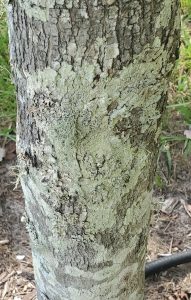
In the same vein of concern are lichens. Many people believe that this organism is a disease of some type that requires control. On the contrary, lichens, often grayish green in color, are a very unique and harmless combination of algae and a fungus. This partnership is mutually beneficial to both parties as the fungus provides water, raw nutrients, and attachment, while the algae make food via photosynthesis. Again, this organism does not obtain any part of its living from the tree or shrub it is attached to. Also, as with Spanish moss and their kin, lichens tend to increase on woody plants as available light increases. There will always be a certain number of lichens on trees – this is normal. A great deal of lichens may be a sign of a declining plant caused by other factors, but not as a result of the presence of lichens.

In conclusion, Spanish moss, ball moss and lichens are generally not detrimental to the health of trees or shrubs. Other stress factors such as root damage from construction activity may cause reduced foliage which slowly allows more light to penetrate resulting in an increased growth of these clingers. So, don’t worry about it! For more information on all types of things that are green, or to ask a question, you can also call the Master Gardener Volunteer Helpdesk on Mondays, Wednesdays, and Fridays from 1 to 4 pm at 764-4340 for gardening help and insight into their role as an Extension volunteer. Ralph E. Mitchell is the Director/Horticulture Agent for UF/IFAS Extension Charlotte County. He can be reached at 941-764-4344 or ralph.mitchell@charlottecountyfl.gov. Connect with us on social media. Like us on Facebook @CharlotteCountyExtension and follow us on Instagram @ifascharco.
Sewards, J. & Brown, S. P. (2023) Spanish Moss, Ball Moss, and Lichens – Harmless Epiphytes. The University of Florida Cooperative Extension Service, IFAS.
Gilman, E. F. (2011) Dispelling Misperceptions About Trees. The University of Florida Cooperative Extension Service, IFAS.
Stevenson, J., Milligan, L. B. & Gillett-Kaufman J. L. (2023) The Life of Lichen. The University of Florida Cooperative Extension Service, IFAS.
Alicia Lamborn (2025) Lichens. The University of Florida Cooperative Extension Service, IFAS – Baker County.
 2
2