When most people think of Burmese pythons in Florida, their minds immediately go to the Everglades. However, these large invasive snakes have become a growing concern much closer to home.
Recently, I had the opportunity to attend a Burmese python safe capture training at Lemon Creek Wildflower Preserve in Englewood. The event was hosted by Park Manager Chad Lyman after a Burmese python was recently observed on the property. The sighting provided a valuable opportunity for local residents, natural resource professionals, and outdoor enthusiasts to learn more about the species and the challenges it presents for Florida’s ecosystems.
Biologists from the Florida Fish and Wildlife Conservation Commission (FWC) led the training, providing information on python biology, how invasive populations are managed in Florida, and what to do if a python is encountered in the wild. Attendees also observed a live safe-capture demonstration and, for those interested, had the chance to safely capture and handle a Burmese python under the supervision of trained staff.
During the hands-on portion, participants learned several of the key principles behind FWC’s safe-capture techniques. Before approaching a snake, biologists emphasized evaluating both the python’s behavior and the surrounding environment to identify potential hazards. Participants were then shown how to safely secure control of the snake’s head and body while minimizing stress to the animal and reducing the risk of injury to themselves. When handling a Burmese python, it’s important to remain aware of the snake’s movements, maintain control of the head, and using proper body positioning to prevent the animal from wrapping around vulnerable areas. The training highlighted that safe python capture relies on preparation, situational awareness, and proper technique rather than strength alone.

Burmese Pythons in Charlotte County
One of the speakers, David Lingenfelser, a FWC Nonnative Fish and Wildlife Biologist, answered questions from participants and discussed the presence of pythons in a portion of southwest Florida. While Burmese pythons are most commonly associated with South Florida and the Everglades, there is a separate established population in Charlotte County. While ultimately unknown, there is no indication at this time that the Burmese pythons in this area are a result of natural migration from the Burmese python population in south Florida. The FWC suspects that initially these animals likely escaped or were released captive animals.
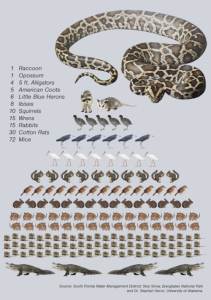
This serves as an important reminder of how quickly invasive species can become established in new areas. Once a breeding population takes hold, removal becomes much more difficult. Because Burmese pythons are adaptable predators capable of consuming a wide variety of wildlife, established populations can place additional pressure on native ecosystems that are already facing numerous environmental challenges.
Living with Pythons
For homeowners, discovering a Burmese python on their property can be alarming, but knowing how to respond is important. The safest option is to keep a safe distance, take note of the location, and report the sighting to FWC. Photos are especially helpful when available. Residents can report python sightings through the IveGot1 app or by calling the FWC Invasive Species Hotline at 888-IVE-GOT1 (888-483-4681). Early reporting provides wildlife professionals with valuable information that helps track new sightings, inform response efforts, and monitor population changes.
The workshop also highlighted ways local residents can become involved in invasive species management efforts. FWC offers training opportunities for those interested in learning more about python identification, reporting, and response. For example, the Python Patrol program provides a free, online Python Patrol Training that is open to the public each third Thursday of the month. More information can be found here: https://myfwc.com/wildlifehabitats/nonnatives/python/removing/. For individuals with extensive experience, contractor programs exist that assist with surveying and removing invasive pythons from targeted areas throughout the state.
Events like this one at Lemon Creek Wildflower Preserve provide more than just information. They provide a hands-on experience which helps to connect residents with the knowledge and resources needed to become active stewards of Florida’s natural areas. Whether it’s learning to identify invasive species, reporting a sighting, or simply sharing information with neighbors, community involvement remains one of the most valuable tools in protecting our local ecosystems.
A special thank you to David Lingenfelser, Lisa Thompson and Anna Deyle for their input.
 5