UF/IFAS Agronomy Department Forage Team
Authored by: Maria Elena Mailhos, Marcelo Wallau, Cheryl Mackowiak, and Diwakar Vyas
As fall approaches, many producers are making decisions on what cool-season forages to plant for grazing, silage or hay production. To help with that decision-making, the UF/IFAS forage team conducts, annually, the cool season forage variety trials. This is a partnership with the seed companies, also supported by the Florida Cattle Enhancement Board and the Milk Check-Off program. The objective is to evaluate commercially available and experimental varieties of annual ryegrass and small grains under Florida conditions, and provide producers with information on forage production, nutritive value, maturity, and disease response.
For the 2025–2026 season, 72 entries of annual ryegrass, oat, rye, triticale, and wheat from 14 companies and breeding programs were evaluated. The complete results are now available in our website (https://programs.ifas.ufl.edu/forage/official-variety-trials/) and are part of the dataset used to define the cool-season forage variety recommendations (https://ask.ifas.ufl.edu/publication/AA266).
Choosing the right varieties for your use and environment
There are many species and varieties of cool-season forages to choose from, and the right one depends on use and environment. They differ significantly in productivity, maturity, nutritive value, disease tolerance, etc. For example, producers targeting one cut for silage or hay often want early and high-yielding materials, whereas those using for grazing are looking for season-long productivity and often will chose a blend of small grains and ryegrasses. Blends also have an important role in adding an extra layer of resilience to the system. This past winter, for example, with the draught and cold weather, many of our cool-season forages struggled. In fact, we saw a 61% reduction in production in our single-cut trials (we wrote about it in this article here: https://www.agproud.com/articles/63014-an-unusual-year-for-cool-season-forages-what-have-we-learned)
Two production trials and a disease nursery
Two separate production trials were conducted. The multi-cut trial was conducted at the Plant Science Research and Education Unit (PSREU) in Citra and focused on hay and grazing potential. The single-cut trial was conducted at White Oak Dairy in Lafayette County, Shenandoah Dairy in Suwannee County, and PSREU and was aimed at silage production.
The multi-cut trial was planted on November 6, 2025, at 25 lb/A for annual ryegrass and 90 lb/A for small grains. Plots were harvested three times: January 9, March 6, and April 10, 2026. Because of the harsh weather, the cutting interval was approximately eight weeks. The single-cut trial was planted between October 29 and November 6, 2025. All cultivars were harvested together, regardless of maturity, following farm management schedules. Harvest dates were between February 5 and February 20, 2026. A separate disease nursery was planted at PSREU on December 10, 2025, using entries from both trials. No cutting was performed, and disease incidence was evaluated twice during the season.
Annual ryegrass
Annual ryegrass was the largest group evaluated in the multi-cut trial. The three harvests provide an opportunity to compare both total seasonal production and the distribution of production across the season.
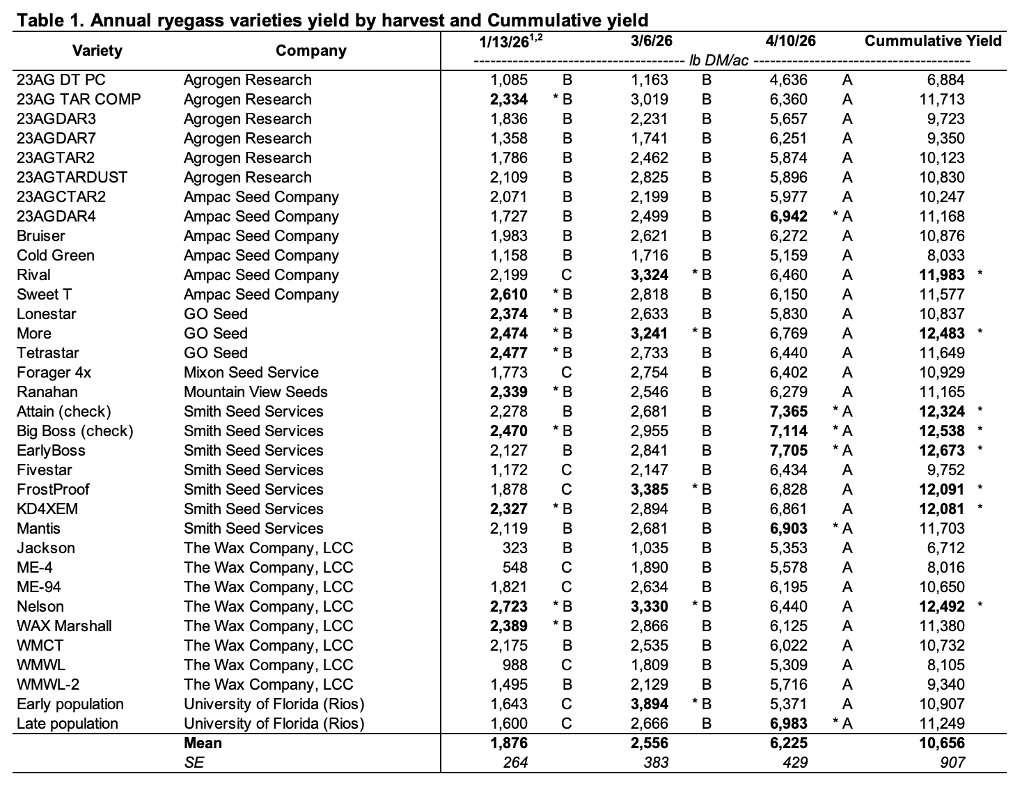
The results show differences among entries in both total production and the amount of forage produced at each harvest. Looking at the individual harvests can be useful when considering how a variety’s production pattern fits a grazing or hay system.
Small grains in the multi-cut trial
Oat, triticale, and wheat were also evaluated in the multi-cut trial. The complete variety-level results are available in the trial report.
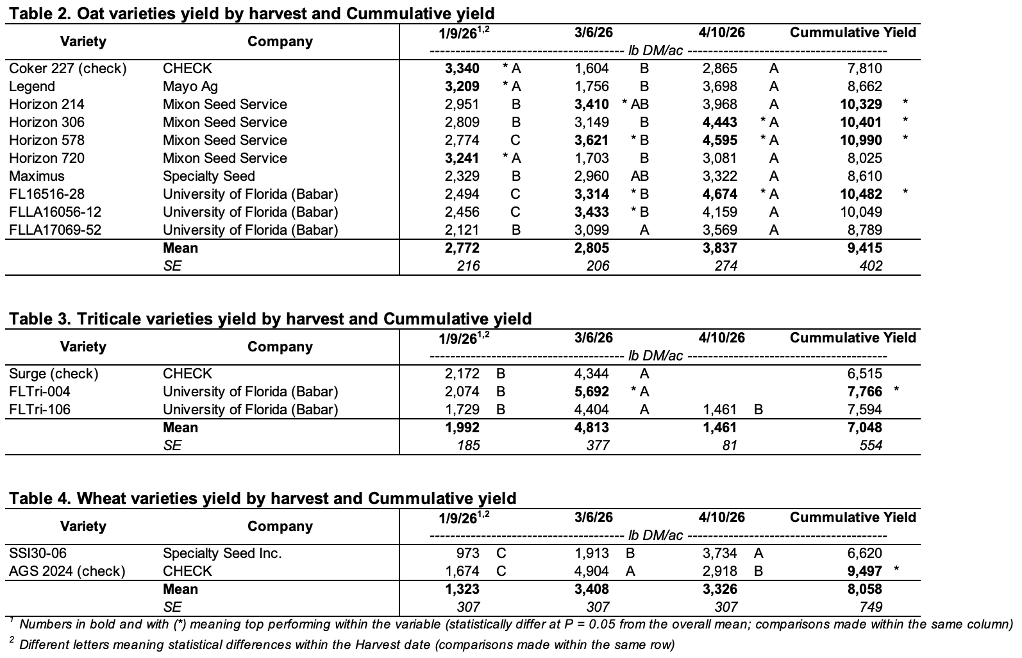
As with annual ryegrass, the small-grain results show differences in both total production and production at individual harvests. The complete tables provide the variety-level results for anyone interested in looking more closely at the materials evaluated.
Single-cut trial
The single-cut trial was managed differently from the multi-cut trial. The crop was harvested once according to the farm’s production schedule, rather than harvesting each variety when it reached the same stage of maturity. This provides information under a defined farm harvest window.
In addition to biomass, samples were analyzed for dry matter and several nutritive-value characteristics. The complete results include annual ryegrass, oat, rye, triticale, and wheat entries.
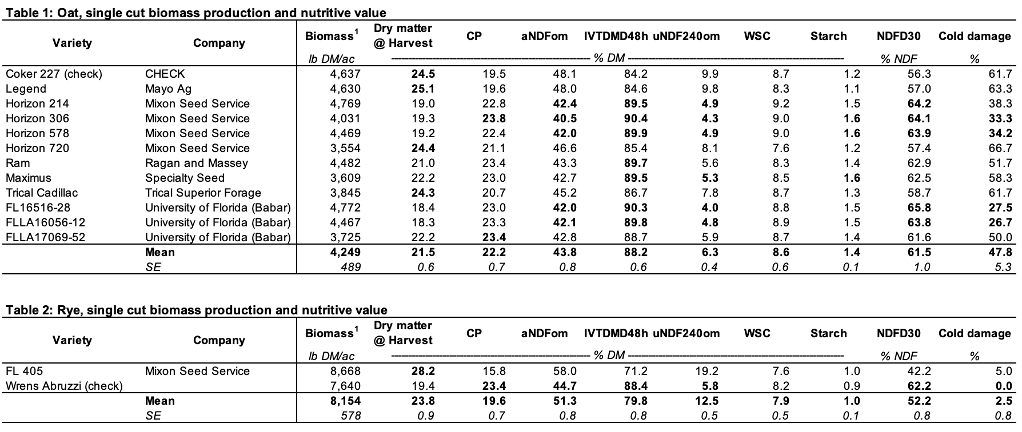
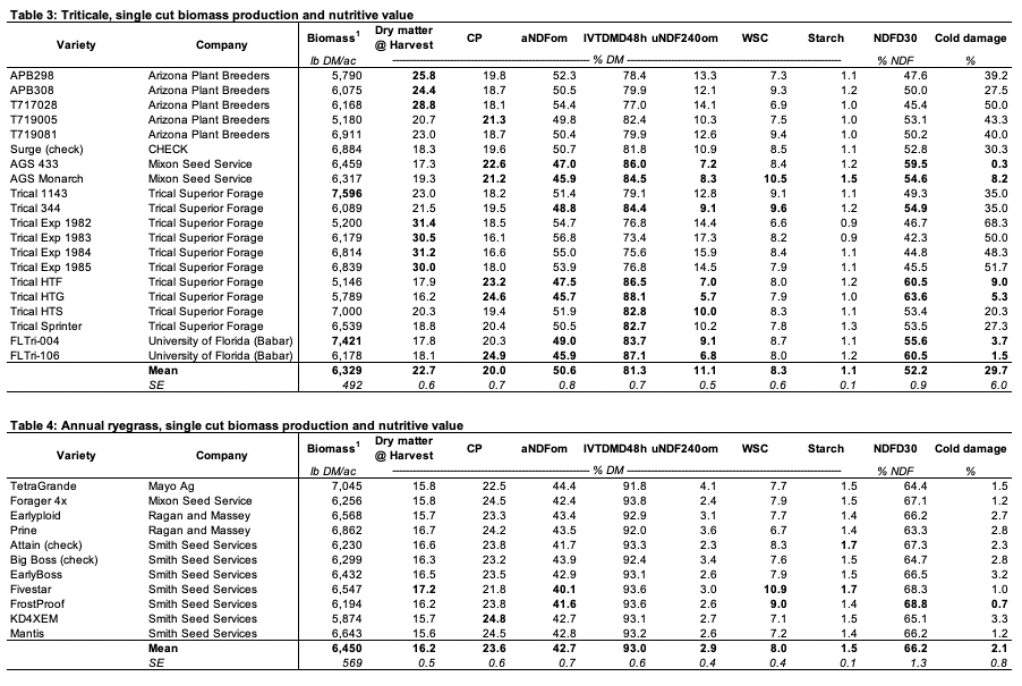

The single-cut data provide more than a yield comparison. The nutritive-value measurements show differences in the forage harvested at the time the trial was cut, providing additional information for producers evaluating forage quality along with production.
Disease nursery
The disease nursery included entries from both production trials. The main diseases observed were leaf spots, rusts, and viruses. Disease incidence was rated on March 20 and April 10, 2026, on a 0–100 scale, with higher values indicating greater disease incidence.
Barley yellow dwarf virus was observed only in oats, and incidence was low. Leaf spot and crown rust incidence varied among entries, particularly in oats and triticale. The complete disease figures and variety-level ratings are included in the full results.
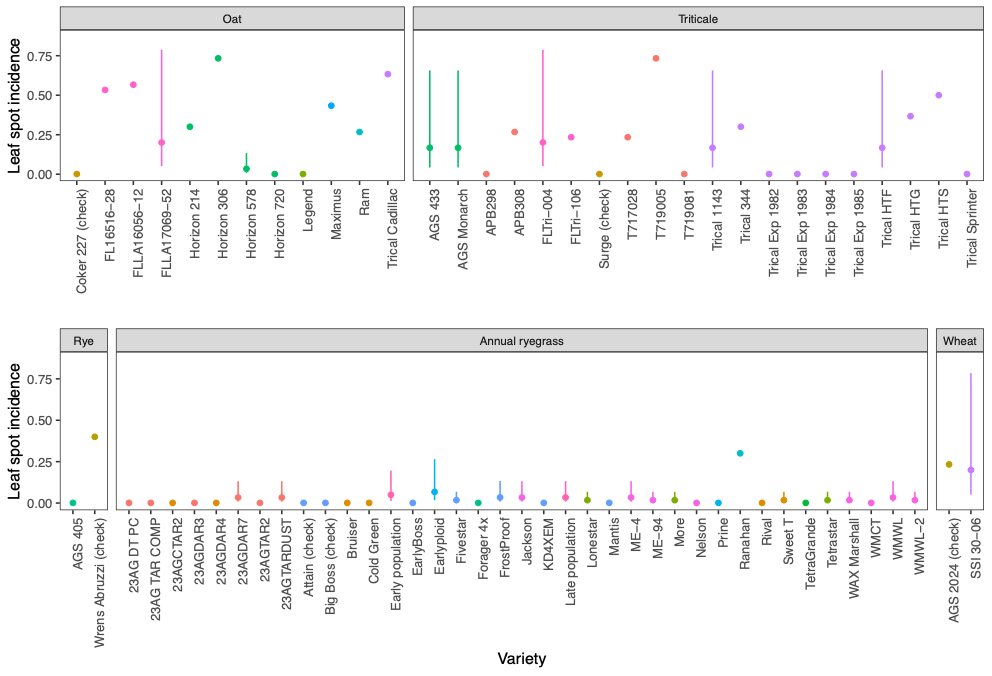
Figure 3: Leaf spot complex Incidence (4/10/26)
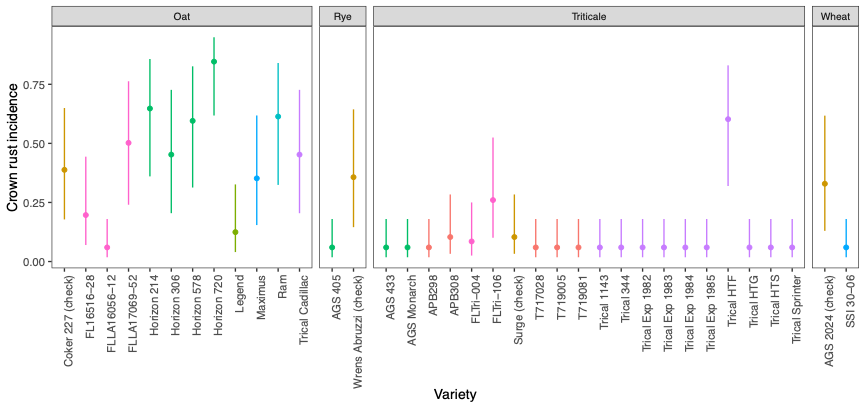
Figure 5: Oat, rye, triticale and wheat, Crown Rust Incidence (4/10/26)
Where to find the complete results
The complete 2025–2026 Cool-Season Forage Official Variety Trial results are available through the UF/IFAS Forage Team’s Official Variety Trials webpage. The full report includes the individual variety results, trial management information, nutritive-value data, and disease observations.
For current variety recommendations, see the UF/IFAS Cool-Season Forage Variety Recommendations for Florida. The recommendation lists are based on multi-location results collected over three years in collaboration with Auburn University and the University of Georgia.
For more information, email the UF/IFAS Forage Team at forages@ifas.ufl.edu or contact your local UF/IFAS Extension office.
 0